

Four announcements, three weeks

Between July 16 and August 7, 4 fitness operators told the market they were growing. Three of them counted locations. The fourth, on July 30, actually published what each member was worth.
Start with the three:
Xponential reported second-quarter results on August 6, and in the same week Club Pilates passed 1,500 studios worldwide.
Crunch announced on August 7 that it had acquired eight Bay Area clubs, doubling its corporate footprint there from eight to sixteen.
EōS Fitness opened nine gyms in the second quarter and now has more than 225 open or on the way.
Three growth stories. Every one of them is true.
But if you read the second paragraph of each story, Xponential’s revenue fell 13% to $66.0 million. It posted a net loss of $4.8 million. North American same-store sales fell 6.8%, against a positive 2.4% a year earlier. Average unit volume, the revenue an average studio actually produces, dropped from $686,000 to $659,000. The company cut full-year guidance, and its board is reviewing a sale.
So Club Pilates crossed 1,500 studios in the same week the av
erage studio lost $27,000 of annual revenue.
Why Crunch bought eight clubs back from its own franchisee
Crunch’s announcement is the most interesting of the three, because it runs backwards.
Franchising is how a gym brand grows without spending its own money. Someone else signs the lease, someone else takes the risk, and the brand collects a fee. Crunch went the other direction and bought eight clubs back from a franchisee it already had in the system.
It did that because those clubs need renovating into the Crunch 3.0 format, and a franchise agreement cannot make eight separate balance sheets fund one renovation schedule. A franchise agreement buys standards. It does not buy capital.
Which means the money went into raising what its existing clubs earn.
EōS is the quietest version of the same thing. The release leads with nine openings and 225 locations. Ten completed retrofits sit in paragraph nine. There is not a single per-member or per-club number anywhere in it.
What Life Time published on July 3
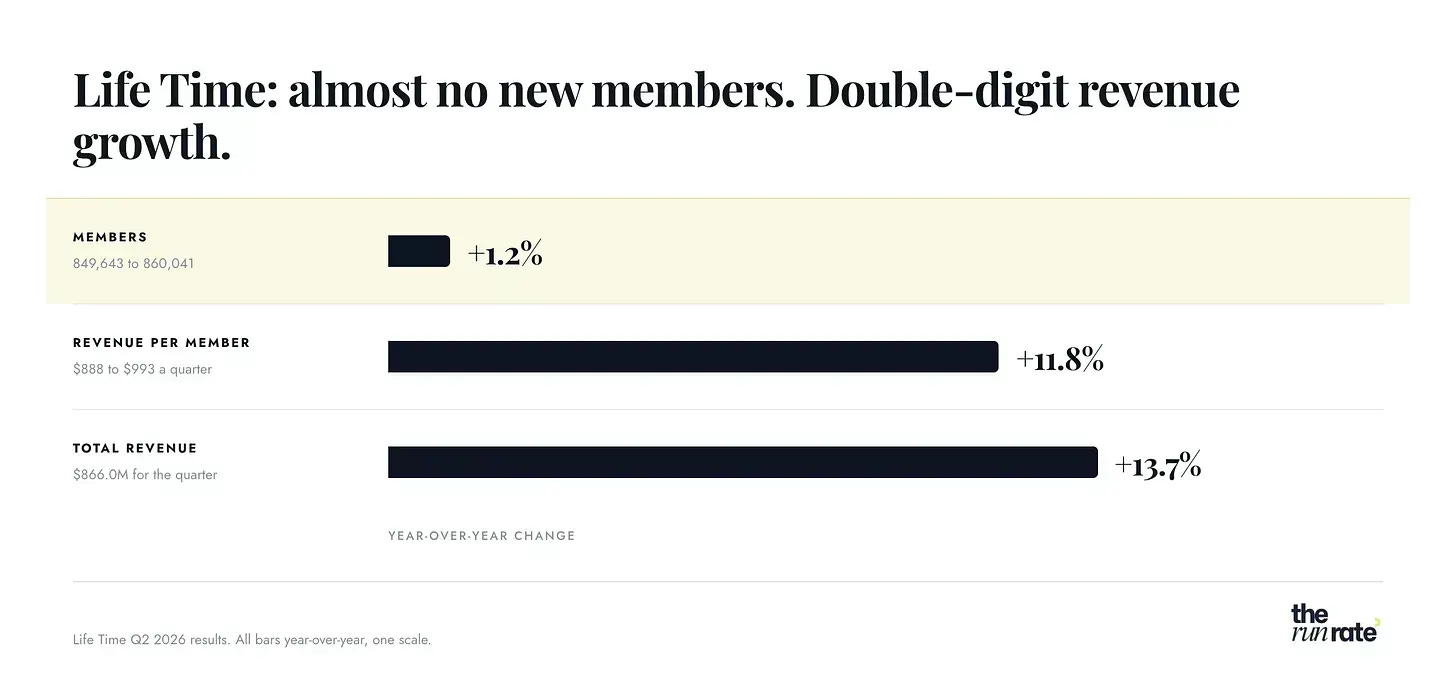
Life Time’s second quarter led with a metric almost nobody else in the industry shares.
Life Time calls it average center revenue per center membership. In Q2 2026 it was $993 for the quarter, up 11.8% from $888 a year earlier. That is roughly $331 per member per month.
Here is the part worth sitting with. Over the same twelve months, Life Time’s membership count went from 849,643 to 860,041.
That is growth of 1.2%.
Total revenue grew 13.7%.
A company added almost no members and grew revenue by double digits, because it grew what each member was worth by 11.8%. And it tells you that, in public, every ninety days.
The Number: 1.2%
Life Time’s membership growth over the year to June 30, 2026.
Revenue over the same period grew 13.7%.
So the pattern is not that the industry has no name for this lever. It’s that the operator pulling it hardest reports it every quarter, and the ones still counting doors do not report it at all.
