

In November 2023, two researchers at La Trobe University published a narrative review in Sports with a title that gave away the finding: “Fundamentals or Icing on Top of the Cake?” They graded recovery strategies against the hierarchy of scientific evidence, from meta-analyses down to case reports, and sorted them into what holds up and what does not.
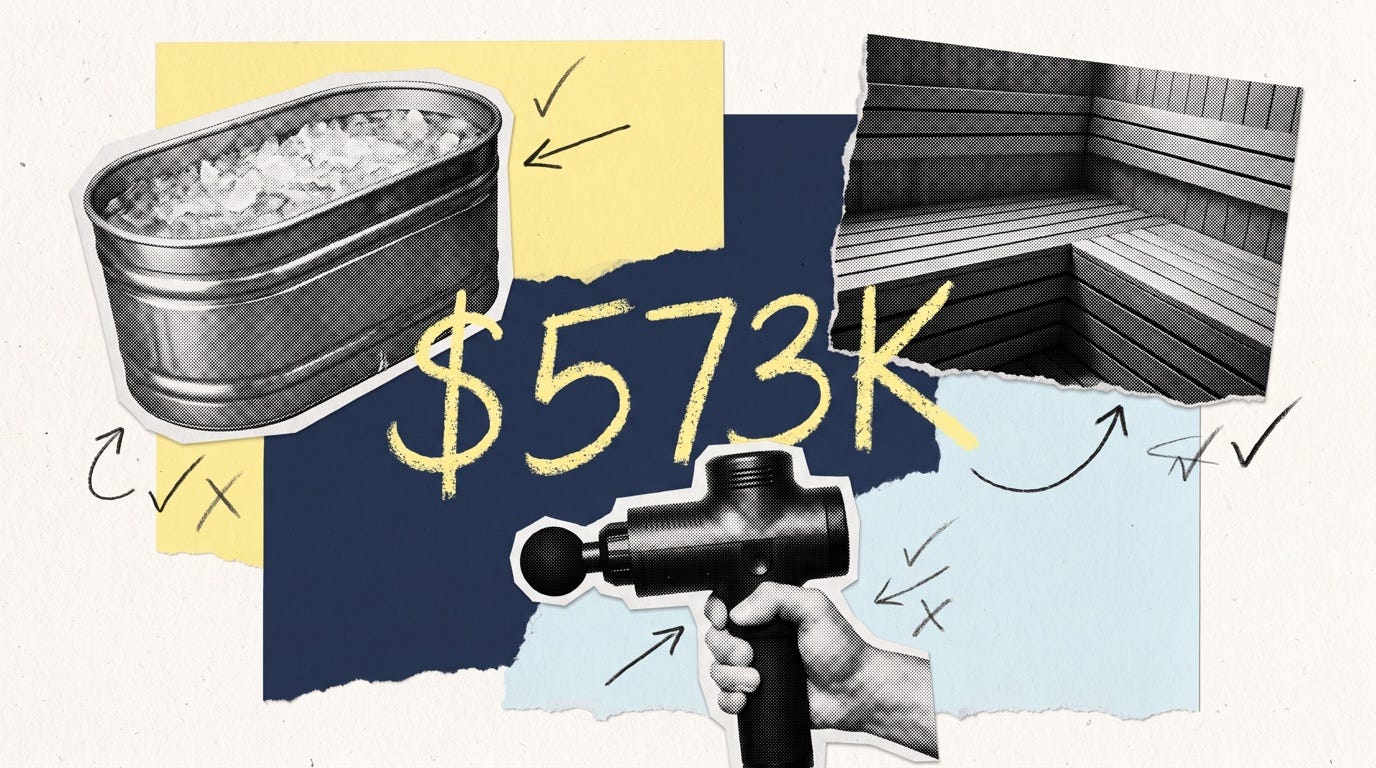
Three years later, the recovery room is one of the fastest-growing formats in fitness. We compared the two side by side.
What the review ranked as well supported: foam rolling, compression garments, cryotherapy chambers, photobiomodulation (red light therapy), hydrotherapy in the form of cold water immersion, and active recovery. Cryotherapy chambers reduced muscle pain in 80% of the post-exercise studies reviewed. Red light showed generally positive findings for muscle fatigue and for strength and endurance performance.
What it graded as thin or mixed:
sauna, which lacks systematic reviews entirely and may impose additional physiological stress.
Recovery boots and sleeves, where most studies report a change in perceived soreness but performance findings are mixed.
Occlusion cuffs, mixed and carrying injury risk.
Massage guns, where the recovery research is limited, two case studies reported serious injury, and one study found a potential increase in soreness.
Stretching came out no better than passive recovery.
The grading has held up, and 2026 sharpened one line of it. Writing in Physiologically Speaking on September 4, exercise physiologist Brady Holmer summarized where the cold plunge research has moved.

Used regularly after resistance training, cold water immersion “reduces muscle protein synthesis in the short term and strength/hypertrophy gains in the long term.” After endurance work the picture is different, and the effects “don’t appear to be detrimental and may sometimes even be helpful.”
That split is commercially significant, and almost nobody selling a plunge makes it.
What about the price list?
SWTHZ sells private suites built around an infrared sauna, a cold plunge and a vitamin C shower. Perspire Sauna Studio sells infrared sauna suites, with red light as a feature inside them. Restore Hyper Wellness runs 225 or more studios on IV drips, cryotherapy, red light and mild hyperbaric oxygen. World Gym’s new Belconnen club, which opened on August 27, bundles a fifteen-person traditional sauna, two ice baths and two ice showers into a Gym and Wellness membership from AU$37.95 a week.
Sauna is the common thread for most of those rooms. It’s the modality the review puts in the thin column. Red light, which grades well, is usually the add-on rather than the anchor.
Recovery is what the research studies. Wellness is what the category sells.
There is a naming question sitting underneath all of this, and it is not cosmetic. The literature studies recovery. The businesses sell wellness. It is Restore Hyper Wellness. It is World Gym’s Gym and Wellness tier. It is SWTHZ describing itself as a luxury wellness studio.
Recovery is a performance claim, and performance claims can be checked against evidence. Wellness is not a claim of that kind. The relabel moves the product outside the reach of the literature that grades it, which is worth noticing before you buy a room full of equipment on the strength of the category’s own language.
The economics under the menu
SWTHZ’s Item 19 disclosure covers the 13 franchised locations open for all of fiscal 2024: average gross sales of $573,762, a median of $556,226, and a range from $438,824 to $718,752. The build cost in the 2026 filing runs $631,798 to $1,314,102, up from $569,757 to $1,193,974 in the 2025 filing.
The average unit does not gross in a year what the cheapest build costs, and the build got more expensive while the category got more crowded. The International Franchise Association expects roughly 15,000 new franchise establishments across the sector in 2026. The underlying equipment markets are smaller than the noise suggests: cold plunge tubs at $381.7 million and sauna and spa at $4.42 billion, both real categories at modest scale, being franchised at a pace that assumes something larger.
The part nobody can sell
The review is clear about where the strongest evidence actually sits. Sleep, nutrition and periodisation are the cake. Devices are the icing. Sleep has the deepest research base of anything in the paper, with documented effects on sprint time, reaction time, aerobic capacity and body composition.
Sleep is also the one recovery intervention nobody can put a turnstile in front of.
As of September, the measurement is free as well. Apple’s Series 12 samples heart rate variability twenty-four times more often than the previous generation and returns a daily readiness score at no charge, alongside a Health Age built on VO2 max, resting heart rate, sleep and HRV. watchOS 27 shipped on September 14 and the watch reached stores on September 18. Oura charges $5.99 a month for the same category of output and WHOOP charges up to $359 a year, which is a point we made about the wearable business and which lands differently here.
Both ends of recovery now cost nothing. The intervention with the deepest evidence was always free. The measurement joined it this month. The part being financed at six and seven figures sits in the middle, and it is the part that grades worst.
That is the same shape as the wider sleep economy, where the products with the most confident marketing cluster around a deficit the customer already feels, and the highest-evidence intervention stays free. A recovery room and a sleep supplement are running the same play. The felt need is genuine. The thing that would most reliably meet it is not for sale.
Three positions, three different problems
What follows from this depends on what you operate, and the three seats are genuinely different.
A gym can bundle recovery as an amenity and never make it carry its own P&L. A standalone contrast studio is underwriting a six or seven figure fit-out against an average unit volume that does not clear it inside a year, while gyms bundle a version of the same menu into a membership. A premium social club is selling the room, the ritual and the people in it, which is why the evidence grade bites least there.
One thing worth doing this week regardless of model: audit which modality your members actually use, by session, before you buy another one. Most operators have never separated the equipment members book from the equipment members walk past. It costs nothing and it takes an afternoon.
The research and the price list rank these products differently, but that gap is the whole business of recovery.
The buy and skip list
Read this as a grading of the evidence, not of the products. A modality in the thin column is not proven useless. It is unproven, which is a different problem, and a more expensive one when you are the person financing the room.
