

This Week on The Run Rate
Weekly Roundup · Aug 22–28, 2026 · Growth Intelligence for Fitness, Wellness & Health Tech
Gym Member Retention: The Benchmark Guide
The industry average is 66.4% annual retention, published in the Health & Fitness Association’s 2025 Benchmarking Report on 2024 data, across 175 companies and more than 17,000 facilities in 27 countries. The figure most operators actually quote is 71.4%, which comes from IHRSA’s Profiles of Success and reports 2015 data. We traced every benchmark we could find back to its publisher, its sample and its data year, and several of the most repeated numbers in this industry do not survive that check. Retention fell about five points between those two samples while membership grew, which is the squeeze sitting underneath every revenue-per-member conversation this year.
Oura Is Being Sued Over Sleep Accuracy.
On August 20 a California resident filed a proposed class action in the Northern District of California, alleging Oura cannot substantiate advertised sleep-staging accuracy of 79% and 95%, and citing peer-reviewed testing that puts overall stage classification at 53.18%. Oura says it stands behind its science, and nothing has been decided. The useful part for operators is the line the complaint draws in public: a ring measures heart rate, HRV, movement and temperature, then infers sleep stages, readiness and recovery from them, and both columns appear in the app in the same typeface at the same size. Members arrive having already decided what kind of day their body is having, and a week of mainstream coverage is the opening for a coach to explain which half of that screen was ever a measurement.
Five Studios, One Membership: What Crunch Select Is Built to Do.
Crunch’s premium banner relaunches as a multi-boutique club, with Reform Pilates, a strength studio, boxing, an abs and glutes studio and an expanded recovery suite all inside the base membership. Very few members switch on a bundle alone, because a bundled class and a specialist studio are different products separated by instructor hours, class size and the people in the room. The cost is the reference point. Boutique studios take roughly 42% of US industry revenue on about 25% of memberships, and that pricing power holds only while a prospect still carries two mental categories instead of one.
EoS Just Licensed HYROX. So Can You, for $130 a Month.
EoS became the first gym chain to put official HYROX Training+ programming inside its member app, across 25 locations, gated behind its premium tier. The licence it used is open to any gym at roughly $130 a month per site, with no square-footage minimum, no equipment quota and no coach certification requirement, and more than 2,500 gyms already hold it. EoS bought attention and moved first, which is a different thing from buying exclusivity. If the question is whether renting a competition format actually builds anything, our Take on how “Pilates’ answer to HYROX” ended is the companion piece.
Crunch Clubs Are Giving Away 2 Million PT Sessions in One Day.
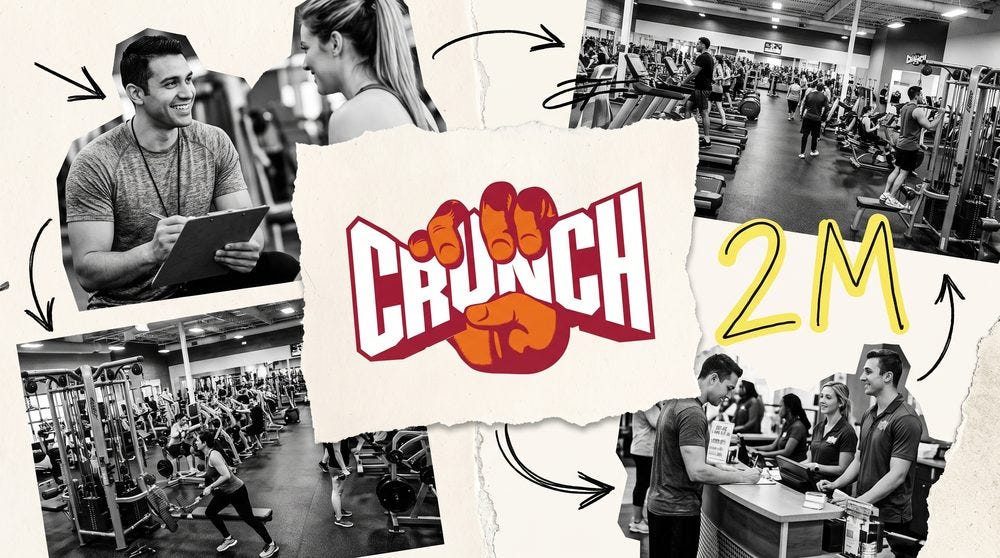
CR Fitness Holdings is one franchise group with 98 Crunch clubs and more than a million members, and on August 29 it offered every one of them two free 30-minute personal training sessions. TRR estimate: ten trainers per club running back-to-back half-hour slots across a 16-hour day tops out near 31,000 sessions, roughly 1.5% of the advertised figure, which is our arithmetic rather than a delivery forecast. The two million is entitlement and the thirty thousand is the business, and the mechanic underneath works the same at forty members as at a million: one day rather than an open-ended offer, sign-up at a bar inside the club, and every staff member running the same play at the same time.
Mark Mastrov Bought 24 Hour Fitness Back. Eight Months Later He Took the CEO Seat.
Mastrov reacquired the company he founded in January with LongRange Capital, returning as owner and executive chair alongside a stated $100 million investment plan. In August, CEO Karl Sanft left and Mastrov took the seat himself on an interim basis. Eight months is a reaction rather than a strategy cycle, and an owner who gives up his one degree of separation from the floor is betting that knowing the member beats knowing the plan. That knowledge is the single asset an independent usually holds more of than the chain down the road, and almost nobody writes any of it down.
Read This Week
Three posts worth your time, from operators publishing the arithmetic most of this industry keeps off the page.
How to Raise Your Prices (and How to Know If You Need To) by Holly Swanson, Pilates Field Guide
Read this next to our Crunch Select piece, because it is the operator-side answer to a price anchor that just moved. Swanson starts with the diagnosis rather than the increase: full classes with a real waitlist, costs that have risen across several lines, or teacher pay that has to go up are reasons to raise, while a slow season, a competitor’s increase, or a cash-flow problem that is actually a cost problem are not. Then the mechanics, which are where most owners lose the room. Tell teachers first and raise their pay in the same breath, give two to four weeks’ notice, quote the increase as the dollars a weekly member will actually feel, and grandfather nobody. Her line on the announcement: “Don’t apologize. It’s always our first instinct to say I’m sorry, I don’t have a choice. You do have a choice.”
When Did Feeling Good Become So Much Work? — Rach Hirsch, The 2% Club

Hirsch looks at the $368 million that has gone into acquiring 22 summer camps, including a reported $80 million bid from Warner Bros’ CEO for a single one, and reads it as capital voting against optimization culture. Her argument is that a $2 trillion wellness industry taught people to treat feeling good as a leaderboard, with HRV, VO2 max and biological age all keeping score, and that the next wave of money goes to the opposite instinct. Worth reading against the Oura story, because both are about members who are quietly tired of being measured.
Your Clients Are Your Influencers — Anna Noelle Rinke, Homebody Studios

US influencer marketing passed $10 billion in 2025 and is forecast to hit $13 billion by 2027, and Rinke walks the practice back through Wedgwood’s royal warrant, Tupperware’s 20,000 dealers and Nike’s first $126 million year with Jordan to separate what each brand was actually borrowing. Wedgwood borrowed status. Nike borrowed reach. Tupperware borrowed belonging, which is the one a studio already owns and the one that stops working the moment community becomes a logo and a broadcast channel. Useful this week if the Crunch bundle has you listing what a big-box membership cannot copy.
That's the week. If someone forwarded you this, subscribe free at newsletter.therunrate.co. And if you want The Take (our twice-monthly opinion issue) plus the full Growth Playbooks library, the paid tier is $8/mo.