

This Week on The Run Rate
Weekly Roundup · Sep 5–11, 2026 · Growth Intelligence for Fitness, Wellness & Health Tech
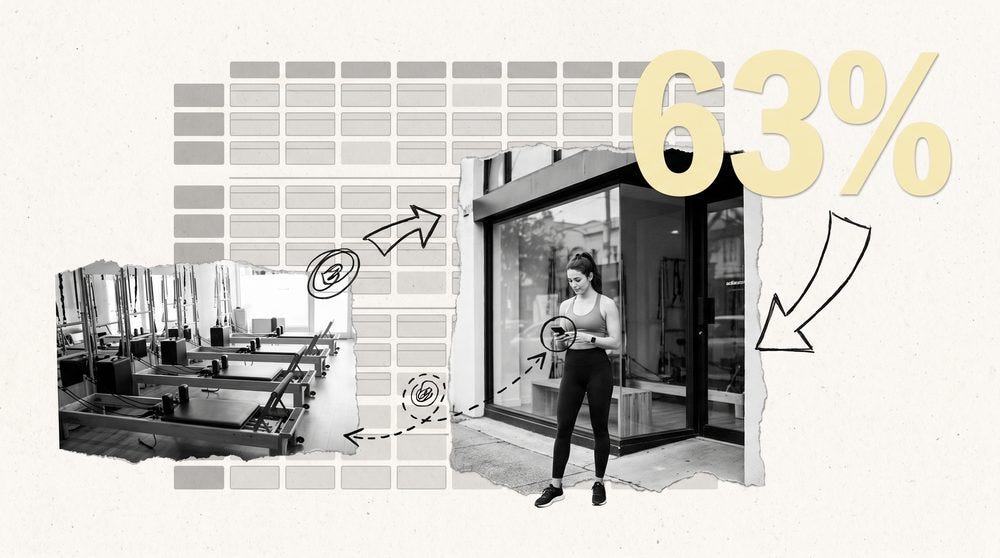
bsport Asked 550 Boutique Members Why They Never Booked. 63% Said the Schedule.
bsport surveyed 550 active boutique members across the US, UK, France, Germany and Spain and asked what stopped them booking the first time. 63% named inflexible class schedules, ahead of inconvenient location at 38% and wanting a trial class at 25%. Price did not lead. A prospect who cannot find a class that fits their week never reaches the pricing page, and in your analytics they look exactly like someone who balked at the price. Of the three barriers, the timetable is the only one you can fix without a new lease or a discount.
Six Days After Oura Filed, Apple Made Readiness Free.
Oura filed for its IPO on September 3 on the strength of a membership that brought in $240.5M over nine months at an 89% gross margin. Six days later Apple put a free daily Readiness score on Apple Watch Series 12, alongside a Health Age score and a $119 panel of 50-plus biomarkers at Quest. The interpretation layer was supposed to be the moat, and Apple made it a default setting. For studios the readiness number stops being something to sell and becomes an input. What you can still charge for is what happens when the score drops.
HYROX Founders Took Back 51%. Everyone Reported a PE Takeover.
Infront completed the sale of HYROX on September 8 and the headlines said private equity had bought it. The ownership table says founders Christian Toetzke and Moritz Fuerste now hold 51%, with L Catterton and WndrCo underneath them as minority partners and Infront fully out, at a reported valuation around €600M. That changes who has to say yes before anyone squeezes the affiliate licence, which EoS pays $130 a month per club for. Founder control buys gyms continuity. A €600M valuation still needs a growth case, though, and one of the four levers runs through your P&L.
Gold’s Gym Built an App for People Who Never Walk In.
Gold’s Gym has more than 550 locations, and this week it launched Hone, a movement, nutrition and body composition app built with Demotu. It is piloting in 46 company-owned clubs, rolls out to all members next, and in 2027 goes on the App Store for anyone, member or not. That last tier is the tell, because a building has a catchment area and an app does not. With fitness apps keeping about 3% of users at day 30, a standalone subscription is a hard bet. As a lead source with a movement assessment already on file, it looks a lot smarter.
Your Booking Software Just Signed a Lease on Bond Street.
Arketa runs booking, payments and websites for thousands of boutique studios, and it has now opened a studio of its own, Powered, at 31 Bond Street in Manhattan. Its stated reason is to understand the demand and pain points operators face, which is a vendor with $22.6M raised saying out loud that it did not fully understand its customers. The gap is everything a dashboard cannot show you: the 5am instructor cancellation, the member whose only workable slot is full every week. The risk for everyone else is a product roadmap that drifts toward studios shaped like Powered.
The Gym Group Raised Prices 5% and Still Added Members.
The Gym Group’s first half: revenue up 10% to £133.1M, revenue per member up 5% to £22.14 a month, and members up 4% to 991,000 across 245 UK sites. A budget operator raised its price and grew volume in the same six months, so roughly half the growth came from price. If the most price-sensitive segment in UK fitness can take 5%, a coached studio charging four times as much has a weaker excuse than it thinks. The moves for pulling that lever are in our Take on growing revenue in double digits while members grow in single digits.
74% of Gym Operators Grew. Only 37% Plan to Open Again.
Xplor surveyed more than 180 gym and leisure operators in 19 countries. 74% grew over the last three years, just 2% declined, and 68% opened a new location. Only 37% plan to open another in the next two years. What is holding them back is supply: 59% struggle to find sites, 60% cite rising member acquisition costs and 56% cannot recruit staff, with the UK seven to ten points worse on every line. Only 36% would consider debt, which explains why so many build from cash flow instead of buying a distressed club.
Life Time Launched LT Social. HYROX Took Its Dating App Global. Neither Charges for It.
Life Time’s LT Social is an application-only community with monthly events at flagship clubs, set to start in New York on September 12 and 13, at no extra cost to members. HYROX took its Surf dating partnership into the UK, Ireland and Latin America, pairing strangers as doubles partners at races. Neither is charging for community, because both are using it to hold a price that classes alone stopped justifying. Life Time’s version needs flagship real estate in eight metros. The HYROX version needs a partner with a marketing budget, which a single-site studio can actually find.
Pickleball Venues Charge $75 a Month for 70,000 Square Feet. The Money Is in Dwell Time.
Pickleball participation grew 479% between 2020 and 2025 to 24.3 million players, and the committed core playing eight or more times a year went from 1.4 million to 7.5 million. Venues like Chicken N Pickle run 30,000 to 70,000 square feet at $75 to $149 a month and hold people for 90 to 120 minutes, because the court fee is the business and the food exists to stretch the stay. A boutique studio charges more for 50 minutes, sells one thing and clears the room. Dwell time is the metric almost no studio tracks.
Read This Week
Three posts worth your time, and two of them are about the number most owners read too quickly: retention.
Your Studio Retention Number Isn’t What It Looks Like — Holly Swanson, Pilates Field Guide
Read this straight after our bsport piece. bsport tells you why people never booked, and Swanson tells you whether the ones who did actually came back. She splits retention into two numbers, the studio’s and each teacher’s, and measures a return inside 60 days, because 30 is too short and 120 means they are not really a regular. 85% or higher is an A+. Filter out unlimited memberships, which show close to 100% and flatter the average, and watch for 5-packs stretched across two months, which count as retention but never become recurring revenue. The schedule shows up here too: a teacher stuck with the 11am to 1pm slots will sit lower than one with the 6am classes, and she says plainly, “A steady 70% in the right context is good.”
Is Every Brand a Fitness Brand Now? — Beyond, Tomorrow’s Tomorrow

Pair this with our Gold’s Gym and Arketa pieces, which are the same move from the other side: a gym selling an app to people who never walk in, and a software company opening a studio. Their argument is that “fitness is no longer a siloed part of a person’s life,” and that the experience now starts hours before the session. Useful context for any studio owner wondering why a member’s attention is harder to hold than it was.
Your Gym Isn’t Underpriced, It’s Under-Retained — Jim Thomas, Jim’s Substack

The counterweight to our Gym Group piece. The Gym Group shows a price rise can work, and Thomas’s point is that it cannot cover for members walking out the back. Sell 50 memberships and lose 45 and you netted five. Cut cancellations to 25 and you added 25 without a single extra lead. Two gyms charging the same rate, one keeping members eight months and the other 24, are running different businesses. His practical asks: flag inactivity at 7 to 14 days instead of 30, run onboarding touchpoints from day one through day 90, and stop using discounts to save a member who has already stopped showing up. The line to take into your next pricing conversation: “Your gym may not be underpriced. It may simply be under-retained.”
That’s the week. If someone forwarded you this, subscribe free at newsletter.therunrate.co. And if you want The Take (our twice-monthly opinion issue) plus the full Growth Playbooks library, the paid tier is $8/mo.