

This Week on The Run Rate
Weekly Roundup · Aug 29–Sep 4, 2026 · Growth Intelligence for Fitness, Wellness & Health Tech
Oura Filed for Its IPO. Their Monthly Subscription Is the Story.
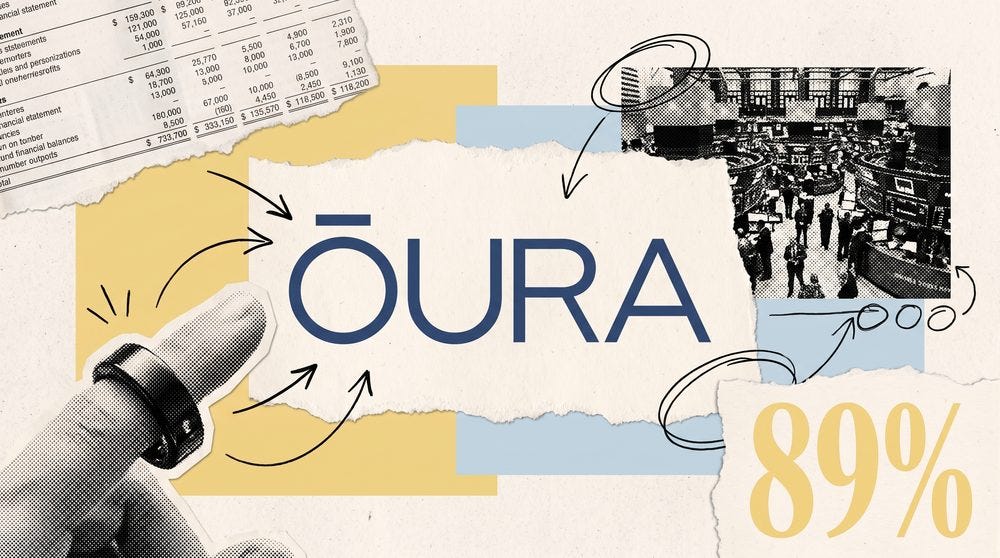
Oura filed its S-1 on September 3. Hardware brought in $974M at a 55% blended gross margin. The membership line brought in $240M at 89% (!), and it grew 121% year over year. The $16B target is priced off the second number rather than the first, which makes the ring an acquisition cost and the subscription the actual business. That is the same shape as a recovery room, a nutrition add-on or a PT package, and most operators are still filing all three under upsell.
Enhance, the PT Software Behind Crunch and UFC Gym, Just Raised $18.2M.
Enhance sells personal training software into high-value low-price gyms, and Crunch, UFC Gym, PureGym and In-Shape already run it. The platform handles 500,000 booked sessions a month across 15,000 trainers and has compounded revenue at 65% a year since 2019. In that model the $10 membership was never the product. It buys the foot traffic that personal training converts, and the raise is a bet that the conversion layer is worth more than the door. If you want the arithmetic on what that does to a P&L, our Take on double-digit revenue growth off single-digit member growth is a good companion read.
How Gen Z Picks Where to Live: The Gym Comes Before the Pub
The Gym Group’s third annual Gen Z survey, 2,000 people, puts the gym ahead of the pub as the amenity that decides where they move, and 44% now rank fitness as their first or second discretionary spend. The demand is real and operators are hunting sites on the back of it. The map many of them are reading is Strava’s heatmap, whose users one 2026 study put at 93.5% male and 93.6% cyclists, and which in Baltimore traced the city’s segregation lines rather than its demand. Activity data and demand data are not the same file, and only one of them is telling you where the members are.
Why Yoga Studios Are Cutting Classes and Adding Pilates
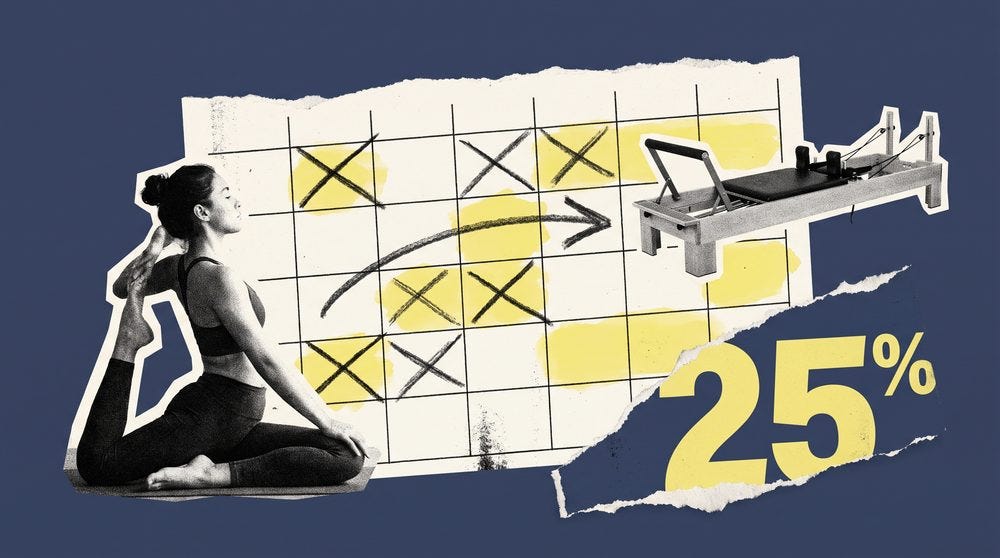
Walla’s veteran yoga studios cut yoga class supply by 25% this year. More than 40% of ClassPass yoga studios now take Pilates bookings too, and Mindbody counts a 20% rise in yoga studios adding Pilates since 2023. Nobody surveyed members and found they wanted less yoga. They just looked at the schedule and the rent bill and reallocated the space, which could mean the yoga industry decline is an effect of more limited supply.
GLP-1 Users Spend 4x More on Fitness. Why This Matters
The Consumer Collective found GLP-1 users report $449 a month on fitness against $120 for everyone else, and that number is being reprinted everywhere with the methodology stripped off. It rests on 123 people inside a 500-person survey with no control for household income, and GLP-1s are expensive, so some of the gap is measuring wealth rather than motivation. There is still a super useful finding underneath it, and it points at acquisition vs price.
Strava’s Strength Push: What It Means for Gyms and Studios
Strava has 195 million users and logged more than 500 million strength sessions last year, and in May it rebuilt strength training around 14 partner integrations. Buried in that launch list is also 24 Hour Fitness, scheduled to follow. When a big-box chain pipes member workouts into someone else’s feed, the streak and the social proof accrue to Strava while the floor space stays yours. There is a good case for doing it anyway - read more.
Why Health Trackers Don’t Change Behaviour, and What Studios Can Sell Instead
Owaves surveyed 1,000 college students, who spend $1,070 a year on wellness products and tracking tools. Eight in ten use a tracker, most check it daily, and one in five report making no behavioural change from any of it. That last group is not a lost cause. They have already paid to be told what to do and are still waiting for someone to tell them, because a tracker reports state and never schedules anything or notices when you stop.
Read This Week
Three posts worth your time, all of them doing the arithmetic the rest of the industry quotes without checking.
Your Favorite Acquisition Channel Is Probably Your Most Expensive One — Courtney Clapper, The Business of Pilates

Read this straight after our Gen Z site-selection piece, because it is the same mistake one layer down: a number that looks like demand and is actually something else. Clapper prices every channel against a lifetime value of roughly $4,000, built from $225 a month, an 80% contribution margin and 24-month retention. ClassPass pays $6 to $15 a class and 94% of its users are new to the venue. Paid social runs $30 to $100 per converted member if you have optimised it and $200 to $400 if you have not. Referrals come in under $25, sometimes as low as $14, and retain 10 to 20 points better at ninety days. Her line on the cheap channel everyone defends: “You’re not paying $6 a class. You’re paying $6 a class, indefinitely, for members you don’t actually own.”
Who Is the $149 Meridian by Whoop Actually For? — Janey Park, The Digital Runway

The other half of the Oura story, from the consumer side. Whoop’s new $149 Meridian band carries the same sensors as its $39 CoreKnit, so the premium is entirely aesthetic, and it costs $50 more than a whole Fitbit Air. Janey reads the hires rather than the product: a Chief Creative Officer, a Samuel Ross partnership, a new Chief Commercial Officer, and 600-plus roles opened this year. Her conclusion is that these companies are repositioning wearables as permanent arm accessories rather than gym equipment. Useful this week if you are wondering why the hardware margin keeps getting spent on design while the subscription quietly does the earning.
Do My Two Studios Actually Compete With Each Other? — Kenzie Wesp, The Founder’s Files

The operator answer to our yoga and Pilates piece, from someone who chose the cannibalization on purpose. Wesp runs TRUEFORM, a Lagree studio, and The Format, heated Pilates, as separate concepts with separate brands, teams and member bases, and she built the second rather than scaling the first for ownership and franchise reasons. Asked the obvious question, she does not hedge: “Yes, we compete! And that’s the cost of doing IT.” Worth reading before you add a second format into the same room and tell yourself the audiences are different.
That’s the week. If someone forwarded you this, subscribe free at newsletter.therunrate.co. And if you want The Take (our twice-monthly opinion issue) plus the full Growth Playbooks library, the paid tier is $8/mo.